Best Hotels in Honolulu: Luxury Beach & City Stays
Key Takeaways
- Hawaii resort fees are not optional and not small. Most Waikiki 4 and 5-star hotels charge $30-50/night as a mandatory resort or amenity fee on top of the room rate. Always factor this into your total cost.
- Wholesale room rates in Honolulu start at $93/night for 4-star properties. Combined with resort fees, the all-in cost is still 20-35% below what mainstream platforms charge for the same rooms.
- Waikiki is where nearly all tourist hotel activity happens. Choosing between hotels often comes down to how close you want to be to the water versus how much you want to pay for that proximity.
- December through April is Honolulu’s busiest season for mainland US visitors. Summer (June-August) draws a mix of mainland and international guests. Shoulder season (May, September-November) offers the best rates with no meaningful downgrade in weather.
Honolulu is the most visitor-friendly city in Hawaii and, by most measures, one of the most expensive hotel markets in the United States. The combination of destination demand, island supply constraints, and resort fee practices means that booking smart here matters more than almost anywhere else. This guide covers each major neighborhood, the resort fee reality, and how wholesale rates compare to what you would find elsewhere.
Understanding Hawaii Resort Fees
Before covering neighborhoods, the resort fee conversation is unavoidable because it directly affects every hotel decision in Honolulu.
Most 4 and 5-star hotels in Waikiki charge a mandatory daily fee variously called a resort fee, amenity fee, or destination fee. This fee covers Wi-Fi, beach chairs, pool access, fitness center use, and other amenities that are included at no extra charge in most city hotels. The fee is charged at check-in and cannot be waived.
Typical resort fee ranges:
- 3-star properties: $20-30/night
- 4-star properties: $30-45/night
- 5-star luxury resorts: $40-60/night
A $93/night wholesale room rate at a 4-star Waikiki hotel with a $38 resort fee has an all-in nightly cost of $131. This is still competitive with what a mainstream platform charges for the room rate alone, but it requires honest accounting when comparing options.
When evaluating any Honolulu hotel, add the resort fee before comparing. The resort fee is typically disclosed in the booking confirmation and charged separately at the hotel.
Waikiki Beach
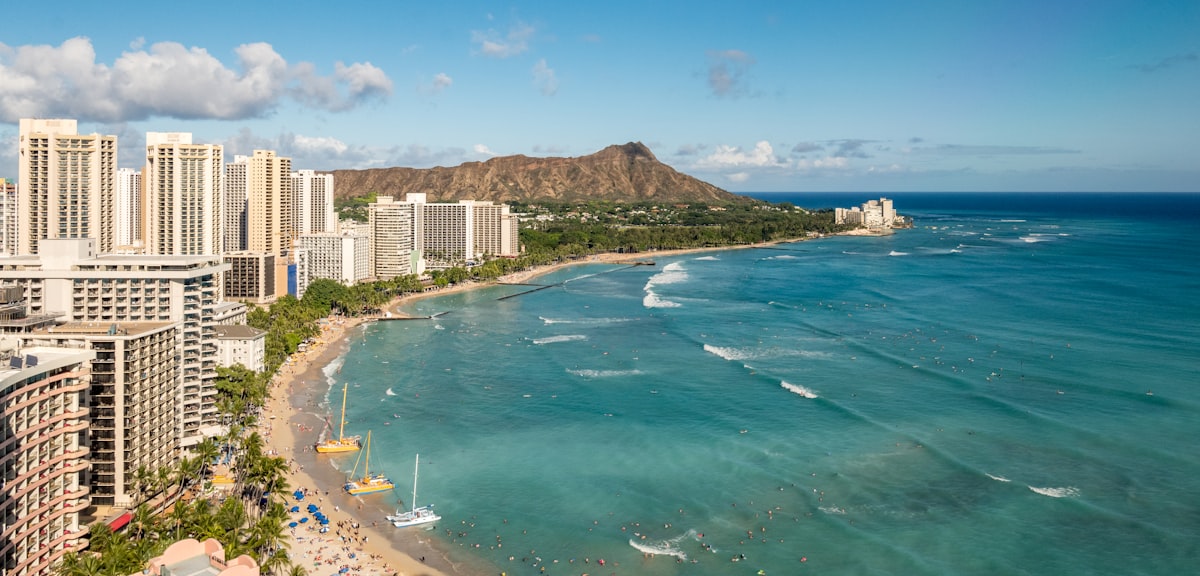
Waikiki is a 2km stretch of Pacific beach framed by hotels and backed by the Diamond Head crater. It is where the overwhelming majority of Honolulu’s tourist accommodation sits, and it is what most visitors picture when they think of Hawaii. The beach itself is public; it is not reserved for hotel guests.
The hotel supply here is the densest in Hawaii. Options range from aging tower hotels dating to the 1960s (which often have lower room rates but can feel dated) to newer 5-star properties with poolside service and curated dining. Location within Waikiki matters: the eastern end near Diamond Head is quieter; the central section near Kalakaua Avenue is closer to restaurants and shopping but busier.
Beachfront vs. city view: Oceanfront rooms with direct beach views command a premium of 25-40% over city-view rooms in the same hotel. City-view rooms in Waikiki are still in Waikiki. If budget matters, the location premium for a water view is real but not necessary for a good stay.
What to expect on price: 4-star Waikiki hotels run $93-160/night at wholesale (room rate, before resort fee). 5-star properties run $200-380/night. Add resort fees of $30-50/night to each of those figures for all-in planning.
Best for: First-time Hawaii visitors, beach-focused trips, families, and anyone for whom proximity to the water is the primary goal.
Ala Moana
Ala Moana sits just west of Waikiki, centered on Ala Moana Center, the largest open-air shopping mall in the United States. The neighborhood is more business-oriented than Waikiki, with a mix of corporate hotels and residential high-rises. Ala Moana Beach Park, a local-friendly beach with less tourist infrastructure than Waikiki, is directly accessible.
Hotels here often charge lower resort fees than Waikiki counterparts, and room rates run slightly lower. The tradeoff is a 10-15 minute walk to the main Waikiki beach strip, though a free trolley connects the two areas.
What to expect on price: 4-star properties in Ala Moana run $93-145/night at wholesale. Resort fees are typically $20-35/night here, slightly below the Waikiki average. The all-in per-night cost is often the most competitive 4-star option in the Honolulu market.
Best for: Value-focused travelers who want beach access without Waikiki prices, shopping-focused visitors, and business travelers to Honolulu who want a quieter base than Waikiki.
Diamond Head
The Diamond Head neighborhood sits on the eastern edge of Waikiki, between the famous crater and the ocean. Hotels here are fewer in number and tend toward boutique or upper-midscale properties. The area is notably quieter than central Waikiki. Kapiolani Park, a large public park at the base of the crater, is directly accessible, as is the quieter Kahala side of the coastal road.
The Diamond Head trail (a hike inside the crater to the summit rim) is the most popular short hike on Oahu. It requires advance reservations and takes 1-2 hours round trip. The views from the rim cover Waikiki, the coastline, and the Pacific.
What to expect on price: Boutique and mid-tier properties near Diamond Head run $105-165/night at wholesale. Resort fees are generally $25-40/night. The combination of quieter setting and comparable pricing to Waikiki makes this a strong option for visitors who plan to split time between the beach and Oahu’s hiking and cultural sites.
Best for: Hikers, couples, repeat Hawaii visitors, and travelers who want beach access without the Waikiki sensory load.
Ko Olina
Ko Olina is a resort enclave on Oahu’s southwest coast, approximately 40km from Waikiki. It is not Honolulu proper, but it is on the same island and warrants inclusion because several major luxury resorts are here, and some travelers specifically choose it over Waikiki.
The Ko Olina lagoons are calm, man-made swimming areas protected from open ocean swells, making them popular with families with young children. The Four Seasons Oahu at Ko Olina and Aulani (Disney’s Hawaii resort) are the anchor properties. The area is self-contained. Leaving Ko Olina for Honolulu requires a car or organized tour.
What to expect on price: Ko Olina 5-star resorts run $350-600/night (room rate). Resort fees here are $50-80/night. These are among the highest all-in rates in Hawaii. Wholesale rates bring top-tier rooms down to $280-480/night before resort fees, which is still a significant figure.
Best for: Families with young children who prioritize calm water over surf, Disney resort guests, and travelers whose primary goal is a self-contained luxury resort experience rather than city and culture exploration.
Downtown Honolulu
Downtown Honolulu is the commercial and government center of the city, distinct from Waikiki in character. Iolani Palace (the only royal palace on US soil), the Hawaii State Capitol, and the historic Chinatown district are here. Hotel supply is limited compared to Waikiki.
The downtown area appeals to visitors interested in Hawaii’s history and culture rather than primarily the beach. It is also where cruise ships dock, making it a practical base for cruise travelers spending time in Honolulu before or after embarkation.
What to expect on price: The few hotels in Downtown Honolulu run $93-140/night at wholesale. Resort fees are less common here than in Waikiki, with some properties not charging them at all. This makes the all-in cost more competitive than most Waikiki options.
Best for: History and culture-focused travelers, cruise passengers, business visitors, and travelers making Honolulu a stopover rather than a primary beach destination.
Honolulu Hotel Price Comparison by Neighborhood
| Neighborhood | 4-Star Room Rate (Wholesale) | Typical Resort Fee | All-In Nightly Estimate | Walk to Beach |
|---|---|---|---|---|
| Waikiki | $93-160 | $30-45 | $123-205 | 0-5 min |
| Ala Moana | $93-145 | $20-35 | $113-180 | 10 min |
| Diamond Head | $105-165 | $25-40 | $130-205 | 5-10 min |
| Ko Olina | $280-480 | $50-80 | $330-560 | 0 min (lagoon) |
| Downtown Honolulu | $93-140 | $0-25 | $93-165 | 25 min |
Room rates reflect wholesale pricing through HotelsLove. Standard booking platforms charge 25-40% more for the same room rates, with identical resort fees on top.
When to Visit Honolulu
May, September, and October are the strongest value months. Weather is nearly identical to peak season. Temperatures hold at 26-29°C (79-84°F) with trade winds keeping the humidity manageable. Hotel room rates drop 15-30% from peak periods. These are strong months to be in Honolulu, not just cheap ones.
December through April is the traditional peak season for mainland US visitors, particularly families during holiday breaks and snowbirds escaping winter. December 20 through January 5 delivers the year’s highest hotel rates. Spring break (March) brings a secondary spike. Rates in January-February outside of holiday windows are more moderate.
June through August is the most expensive summer period. International visitor numbers are at their highest. Mainland families are active. Rates match or slightly exceed winter peak in Waikiki. The weather is warm, the water is calm on the south shore (Waikiki’s side), and surf is gentle. For a family summer trip, the rates are high but the conditions are straightforward.
North Shore in winter: If you are visiting between November and February and have any interest in surfing or surf watching, the North Shore of Oahu delivers the world’s largest rideable surf at Waimea Bay and Pipeline. Day trips from Honolulu take 60-90 minutes by car. Hotel supply on the North Shore is limited; most visitors day-trip from Waikiki.
Honolulu-Specific Travel Tips
Resort fees are mandatory. They cannot be waived by calling the hotel, requesting an upgrade, or citing a loyalty program membership. Budget for them. Any quoted room rate that does not include them is showing you an incomplete number.
Getting around Oahu without a car is possible but limiting. The TheBus network covers the island thoroughly and costs $3 per ride or $7.50 for a day pass. The main tourist corridor (Waikiki to Diamond Head, Ala Moana, and Downtown) is navigable by bus or the Waikiki Trolley. Day trips to the North Shore, Kailua, or Ko Olina require a car, a tour bus, or a significant time investment on public transit.
Renting a car: If you plan to explore beyond central Honolulu, renting a car for 2-3 days is more efficient than relying on tours. Rental cars at Honolulu International Airport (HNL) are in high demand; booking in advance is advisable. Parking in Waikiki costs $25-50/night at most hotels (another line item to factor in).
The time difference: Hawaii Standard Time (HST) is UTC-10, with no daylight saving time. From New York, the difference is 5-6 hours. Jet lag westbound to Hawaii is mild for most travelers, but the early wake-up on the first 1-2 mornings is common and worth planning around.
Sun and reef: Honolulu’s reef systems are part of what makes the water worth being in. Sunscreen labeled “reef-safe” (free from oxybenzone and octinoxate) is required by Hawaii state law at state parks and strongly encouraged everywhere. Most hotel gift shops carry compliant options.
Frequently Asked Questions
Are resort fees negotiable in Honolulu hotels? No. Resort fees in Waikiki and most Honolulu hotels are mandatory and non-negotiable. They are not optional add-ons. Budget for them as part of the room rate when comparing hotels.
Which area of Waikiki is best for families? The eastern end of Waikiki near Kapiolani Park and the quieter stretch of beach there is generally more family-friendly than the central strip. Ala Moana’s calm beach park is another strong option for families with young children. For younger children who need very calm water, Ko Olina’s lagoons are purpose-built for that purpose.
How far is the airport from Waikiki? Honolulu International Airport (HNL) is approximately 10km from Waikiki. By cab or rideshare, the trip takes 20-30 minutes and costs $30-45. TheBus routes connect the airport to Waikiki for $3, but with luggage, the cab or rideshare is more practical.
Is it worth staying somewhere other than Waikiki? If your primary goal is beach access and the full Hawaii hotel experience, Waikiki makes sense for most visitors. If you are returning to Oahu, have a rental car, or are primarily interested in culture and history over beach time, Diamond Head, Ala Moana, or Downtown Honolulu offer meaningful alternatives at lower all-in costs.
What is included in a typical Waikiki resort fee? Common inclusions are in-room Wi-Fi, pool access, fitness center access, beach chairs or loungers, one or two welcome drinks, cultural activities such as lei-making or ukulele lessons, and local phone calls. The specific inclusions vary by hotel. Check the resort fee disclosure in your booking confirmation for the exact list.
Related Guides
- Best Beach Hotel Deals: Luxury Resorts for Less
- Luxury Hotels Under $200: Top Picks From Miami to Bali
Ready to book? Compare wholesale hotel rates in Honolulu across every neighborhood, resort fees disclosed.