Best Hotels in Montreal: Luxury Stays by Neighborhood
Key Takeaways
- Montreal’s 4-star hotel market starts at $89/night at wholesale, compared to $150-280/night on standard platforms. The savings are largest during summer festivals, when mainstream prices inflate heavily.
- Old Montreal offers the most visually distinctive hotels in the city. Historic stone buildings, cobblestone streets, and the St. Lawrence River nearby make it the most requested base for leisure travelers.
- Grand Prix weekend (early June) and Jazz Festival (late June to early July) drive the two biggest hotel price spikes of the year. Rates double for those weeks. Book 3-4 months ahead or avoid entirely if budget is a concern.
- Quebec’s provincial hotel tax (3.5% lodging tax plus federal GST and provincial QST) adds approximately 15-17% to your room rate. This is standard across the province.
Montreal is one of the few North American cities where the question of which neighborhood to stay in is a real debate. Old Montreal has the stone buildings and river access. Downtown has the restaurants and nightlife. The Plateau offers a local feel that neither provides. This guide covers each major neighborhood, how prices compare, and what actually matters when choosing where to book.
Old Montreal (Vieux-Montreal)
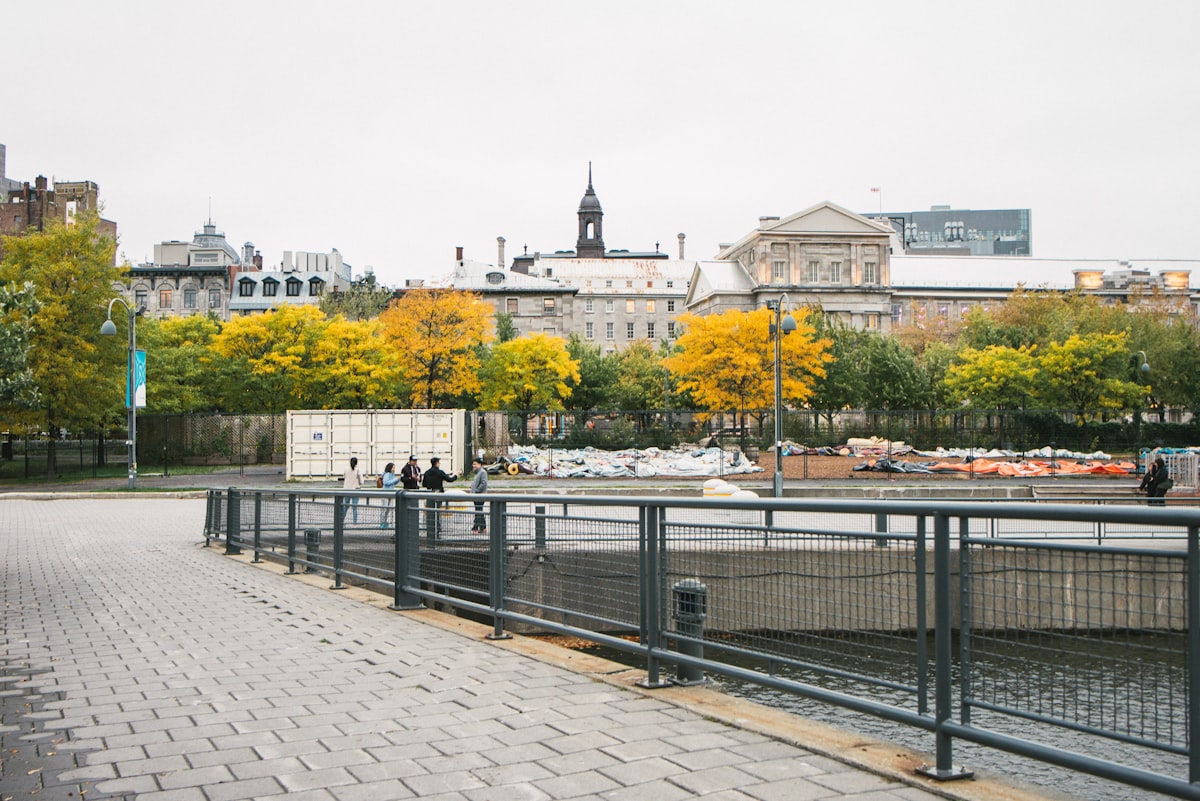
Old Montreal is the original French colonial settlement at the edge of the St. Lawrence River. The neighborhood covers roughly a square kilometer of 17th and 18th-century stone buildings, cobblestone streets, and a historic port that now functions as a waterfront promenade and market. The Basilique Notre-Dame de Montreal, one of the finest Gothic Revival churches in North America, sits at its center.
Hotels here occupy converted historic buildings. The architecture is not decorative; the stone walls, exposed beams, and century-old ironwork are the actual structure. Boutique operators have turned former banks, warehouses, and commercial buildings into 4 and 5-star properties. The result is a hotel category that feels different from anywhere else in the city.
The neighborhood quiets down after midnight on weekdays but fills with visitors in summer. Parking is limited and expensive. The Champ-de-Mars and Place d’Armes metro stations serve the area.
What to expect on price: Boutique 4-star hotels in Old Montreal run $110-180/night at wholesale during shoulder season. Summer rates push to $145-240/night. During the Grand Prix or Jazz Festival, rates in this neighborhood move to $250-400/night on mainstream platforms. Wholesale rates during those events typically run $180-290/night.
Best for: First-time visitors, leisure travelers, couples, and anyone who values architectural character over scale. Old Montreal is the most visually compelling neighborhood in the city.
Downtown Montreal
Downtown Montreal is compact and dense, centered on Rue Sainte-Catherine and the underground RESO network, an interconnected series of tunnels, shopping concourses, and transit connections that runs 33km beneath the city. In winter, the RESO is legitimately useful. In summer, it is a curiosity.
The downtown hotel market is the largest in the city. Major international chains operate here, alongside independent boutique hotels on quieter cross streets. McGill University sits on the edge of downtown, and the Mont-Royal summit is a 30-minute walk north. Place des Arts, the main performing arts complex, is here, as is the Montreal Museum of Fine Arts.
What to expect on price: Downtown 4-star hotels offer the widest price range. At wholesale, they run $89-155/night in shoulder season, making downtown the most accessible entry point for 4-star accommodation in Montreal. Summer rates move to $125-200/night.
Best for: Business travelers, first-time visitors who want flexibility, and travelers arriving on late flights (downtown hotels are closest to both the Bell Centre arena and major transit).
Plateau Mont-Royal
The Plateau is Montreal’s creative core. Rue Saint-Laurent (The Main) runs through it, separating east and west in the city’s traditional division. The streets off The Main and the parallel Rue Saint-Denis are lined with independent restaurants, coffee shops, record stores, and the staircases that characterize Montreal’s residential architecture.
Hotel supply on the Plateau is thin. Most accommodation is short-term rentals and a handful of boutique guesthouses. The few proper hotels here are smaller properties that appeal to visitors who want the neighborhood experience over full hotel amenities. The Plateau is a 25-minute walk from Old Montreal and well served by the 55 bus along Saint-Laurent.
What to expect on price: Boutique accommodation on the Plateau runs $89-135/night. Lower prices than Old Montreal reflect the smaller scale and limited amenities of most properties here.
Best for: Return visitors to Montreal, long-stay travelers (5+ nights), food and nightlife-focused trips, and visitors who find tourist-zone hotels too insulated from the city’s actual life.
Mile End
Mile End is north of the Plateau and shares its character, but with a distinct overlay. It is the neighborhood most associated with Montreal’s music scene and its historically Jewish community (several renowned bagel shops, open 24 hours, date to the mid-20th century). Rue Bernard and Rue Fairmount are the main commercial streets.
Like the Plateau, hotel supply here is small. A few design-forward boutique hotels have opened in recent years, and the neighborhood rewards guests who are willing to explore beyond the city center.
What to expect on price: Boutique properties in Mile End run $89-130/night at wholesale, among the lowest 4-star rates in the city.
Best for: Music and culture-focused travelers, longer stays, and visitors who plan to spend as much time eating and wandering as sightseeing.
Golden Square Mile
The Golden Square Mile (Mille Carre Dore) is a historic enclave on the slopes of Mont-Royal, just above downtown. It was home to Montreal’s English-speaking financial elite in the late 19th century, and the mansions and churches from that period remain. McGill University’s main campus occupies a large portion of the neighborhood.
Several of Montreal’s most prestigious hotels operate in this area. The combination of hilltop location, proximity to downtown, and historic setting makes it attractive for both leisure and business travel at the upper end of the market.
What to expect on price: 5-star and upper-4-star properties in the Golden Square Mile run $150-240/night at wholesale during shoulder season. Summer rates reach $200-320/night for the most sought-after addresses.
Best for: Luxury-focused travelers, longer visits that benefit from Mont-Royal proximity, and travelers who want high-end hotel experience with a quieter, more residential setting than downtown.
Montreal Hotel Price Comparison by Neighborhood
| Neighborhood | 4-Star Avg (Shoulder) | 4-Star Avg (Summer) | 5-Star Avg (Summer) | Walk to Old Montreal |
|---|---|---|---|---|
| Old Montreal | $110-180 | $145-240 | $200-350 | 0 min |
| Downtown | $89-155 | $125-200 | $180-300 | 25 min |
| Plateau Mont-Royal | $89-135 | $110-170 | N/A | 35 min |
| Mile End | $89-130 | $105-160 | N/A | 45 min |
| Golden Square Mile | $150-240 | $200-320 | $250-400 | 30 min |
Prices reflect wholesale rates available through HotelsLove. Standard booking platforms charge 25-40% more for the same properties.
When to Visit Montreal
May and early June are underrated. Temperatures climb to 16-22°C (61-72°F) by late May. The city’s terrasse culture kicks in, with outdoor restaurant seating filling up across the Plateau and Old Montreal. Hotel rates run 20-30% below peak summer prices.
Late June and July are peak season and peak price. The Jazz Festival (late June to early July) is one of the largest music festivals in the world, drawing 2 million visitors over 11 days. Grand Prix weekend in early June is a separate spike. Both events push hotel rates to their annual highs, particularly in Old Montreal and Downtown. If you are not attending these events, shifting your travel dates by one or two weeks either side saves significant money.
August and early September remain warm (22-26°C / 72-79°F) with fewer event-driven price spikes. The fall foliage on Mont-Royal begins in late September and is worth making time for.
October is one of Montreal’s best months. Temperatures drop to 10-15°C during the day, but the city stays active. The fall restaurant and arts programming is rich. Hotel rates fall 25-35% below July peaks.
November through March is winter, and Montreal is serious about it. Temperatures regularly reach -15°C (5°F) or below. The RESO underground network becomes practically useful. Hotel rates are at their annual low. Winter festivals, including Igloofest (January-February) and the Fete des Neiges, give the season a reason to visit beyond price alone.
Montreal-Specific Travel Tips
Languages: Montreal is a bilingual city in practice, with French as the official and dominant language. Most hotel staff, restaurant servers, and retail workers speak fluent English. A few words of French go a long way culturally even if they are not required operationally. The common greeting in a Montreal business is “Bonjour/Hi,” combining both languages.
Tipping: Follow North American tipping norms. 18-20% at restaurants, $2-5 CAD per night for housekeeping, standard taxi gratuities.
Getting around: The STM metro has 4 lines and covers the central neighborhoods efficiently. The 747 express bus connects downtown to Montreal-Trudeau Airport (YUL) in 45-55 minutes for $10 CAD (about $7.50 USD), running 24 hours.
The bagels: Montreal bagels (from Fairmount Bagel or St-Viateur Bagel, both in Mile End) are smaller, denser, and sweeter than New York bagels. Both shops are open 24 hours. This is not optional. Go before you leave.
Smoked meat: Schwartz’s Deli on Saint-Laurent has been making Montreal smoked meat since 1928. The line moves fast. The medium-fat option is the standard recommendation.
Frequently Asked Questions
What is the best time to find cheap hotel deals in Montreal? November through March offers the lowest rates, often 40-50% below July prices. For a combination of good weather and reasonable rates, May and late August are the best value windows.
Does Montreal charge resort fees? No. Montreal hotels do not typically add resort fees. You will pay provincial and federal taxes at checkout (approximately 15-17% combined), but no destination marketing fees are standard practice.
Is it better to stay in Old Montreal or Downtown? For a first visit focused on culture, history, and the scenic waterfront, Old Montreal wins. For flexibility, more restaurant options, and slightly lower rates, Downtown is a practical alternative. The two neighborhoods are 25 minutes apart on foot.
Can I get around Montreal without speaking French? Yes. English is widely spoken in tourist areas, hotels, and most restaurants. Learning basic French phrases is courteous and appreciated, but not necessary for a comfortable visit.
When is the Grand Prix and should I plan around it? The Canadian Grand Prix takes place at Circuit Gilles Villeneuve (Ile Notre-Dame) in early June, typically the second weekend of June. Hotel rates in the city double for that weekend and spike for the surrounding week. If you are not attending, shift your travel dates to avoid it.
Related Guides
- Best Time to Book Hotels: Month-by-Month Price Guide
- How to Find Cheap Luxury Hotels: 8 Tactics That Work
Ready to book? Compare wholesale hotel rates across Montreal’s neighborhoods.